
Understanding NOI is essential for evaluating and driving real estate valuations effectively. This blog will walk you through the ins and outs of NOI, how it influences property values, and its significance in the broader landscape of real estate investment.
Understanding Net Operating Income
In simple terms, Net Operating Income is the total revenue generated from a property minus its operating expenses. This metric is vital as it provides a clear snapshot of a property’s cash flow potential.
Net Operating Income directly impacts an investor’s ability to assess a property’s financial health and determine its market value, as higher NOI typically leads to greater property valuations and enhanced cash flow potential.
Calculating Net Operating Income
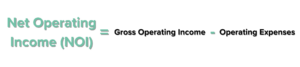
Net Operating Income is determined by subtracting operating expenses from gross operating income.
Components of NOI
- Gross Operating Income: This includes all the income generated from tenants before operating expenses.
- Operating Expenses: These encompass costs necessary to maintain the property, including property management fees, maintenance, insurance, and property taxes.
Other Terms You Should Know
- Cap Rate: The Capitalization Rate, or “cap rate,” serves as a market-driven proxy for property valuation. It represents the ratio of net operating income to property value. This metric reflects investor expectations and market conditions, making it crucial for assessing a property’s overall appeal.
- Cash Flow: Cash flow is the difference between the total amount of money received from tenants and expenses involved in owning and managing the property.
- Debt Service: Debt service refers to the payment due on any outstanding debt (such as a mortgage) related to the property.
Sample NOI Calculation
To illustrate the use of NOI as a valuation tool, consider a commercial property with the following annual figures:
- Gross Operating Income: $150,000
- Operating Expenses: $60,000
In this case, the NOI would be calculated as:
NOI = Gross Operating Income – Operating Expenses
NOI = $150,000 – $60,000 = $90,000
If the cap rate for similar properties in the market is 8%, the estimated property value would be:
Estimated Value = NOI / Cap Rate
Estimated Value = $90,000 / 0.08 = $1,125,000
How to Improve NOI

As an investor or property owner, it is essential to continuously look for ways to improve your NOI. This not only increases the value of your property but also maximizes your return on investment.
Here are 7 ways on how to improve NOI:
#1: Reduce Operating Expenses
Look for ways to cut costs without sacrificing the quality of your property. Negotiating better deals with suppliers, implementing energy-efficient measures, and reducing unnecessary expenses can all contribute to a higher NOI.
#2: Increase Rental Income
Analyze the market and adjust your rental rates accordingly. A small rent increase can have a significant impact on your NOI.
#3: Implement Value-Adding Strategies
Consider making improvements or renovations to increase the desirability and value of your property. This could include adding amenities, upgrading appliances or finishes, or reconfiguring layouts.
#4: Improve Tenant Retention
Keeping good tenants is essential for maintaining a steady stream of income. Offer incentives for lease renewals and ensure prompt response to maintenance requests to keep tenants satisfied and reduce turnover.
#5: Invest in Marketing
A well-marketed property can attract higher-paying tenants, reducing vacancy rates and increasing rental income.
#6: Explore Alternative Revenue Streams
Consider offering additional services or amenities to generate extra income, including charging for parking spaces, laundry facilities, or pet fees.
#7: Stay Informed about Market Trends
Keep an eye on market trends and adjust your strategies accordingly. For example, if the demand for short-term rentals is high in your area, consider converting some units into furnished rentals for a higher return on investment.
Going Deeper Into Net Operating Income
Let’s dive deeper into more advanced discussions around net operating income.
How Can Fluctuations in the Rental Market Affect NOI?
Market dynamics, including shifts in demand and competition, can lead to changes in rental rates and occupancy levels. A comprehensive analysis of these factors is crucial for accurate NOI forecasting.
What are the Best Practices for Accurately Estimating Operating Expenses?
Common pitfalls in estimating operating expenses can lead to significant discrepancies in NOI calculations. Implementing strategies such as detailed expense tracking and historical data analysis can help mitigate these risks.
Conclusion
In summary, Net Operating Income is not just a numerical value; it’s a cornerstone of real estate investment analysis. By grasping its intricacies, you can enhance your valuation techniques and make informed decisions that drive your investment success. Continuous study and exploration are encouraged for those looking to deepen their knowledge of real estate valuation techniques—there’s always more to learn in the dynamic world of real estate!

Balancing Volatility Using Real Estate
Market volatility is not new. What has changed is the speed and synchronization of movement across asset classes. Inflation data,…

The New Housing Reality in Eastern Washington
Rent vs Buy: Housing affordability isn’t a one-sided problem anymore For years, the housing conversation was framed as a simple…

From Curious to Committed: Preparing for Your First Syndicated Real Estate Deal
Most people don’t become real estate investors overnight. They start where many of our investors do — with a strong…

From Macro to Micro: Making Sense of Economic Trends as a Multifamily Operator in Eastern Washington
If you’re a multifamily investor or operator in markets like Tri-Cities, Spokane, or elsewhere in Eastern Washington, chances are you’ve…

What Institutional Capital Is Telling Us About Multifamily in 2026
Where the Big Players Are Moving in Q1 2026 When institutional capital shifts direction, it often signals a deeper current…

Pacific Northwest Multi-Family: Moving Past Cap Compression—Even If Some Sellers Haven’t
This article written Q1, 2026 Cap rate compression has been a driving force in real estate for much of the…

Where to Put Capital in 2026? Here’s How We’re Thinking About It
The market’s not easy to read—headlines are mixed, rates remain uncertain, and many asset classes are still resetting. But while…

A Once-Per-Decade Opportunity Is Beginning to Emerge
Multifamily continues to lead all asset classes in investment activity nationwide, and that’s not changing. Over the past few years,…

Sponsor alignment in the search for capital
For those that are new to syndicated deals or multifamily development. The “Sponsor” is the group putting the deal together.…